CIONIQ Vendor Independence Model™
CIONIQ has a structured toolkit of seven proprietary frameworks that we use across every engagement:
- CIONIQ Governance Framework™
- CIONIQ Modernization Playbook™
- CIONIQ Vendor Independence Model™
- CIONIQ Higher-Ed IT Operating Model™
- CIONIQ Risk & Resilience Compass™
- CIONIQ Admissions Integration Blueprint™
- CIONIQ Fractional Leadership Operating Model™
Together, these frameworks give presidents, CFOs, and CIOs a consistent way to regain control of their technology agenda, make defensible decisions, and move faster without handing the steering wheel to vendors. You can read more about these at https://cioniq.com/cioniq-frameworks.
This article is the third in that series and focuses on the CIONIQ Vendor Independence Model™
CIONIQ Vendor Independence Model™
In higher education today, it’s common to outsource major parts of IT—ERP hosting, help desk, security operations, even the CIO role itself. Done well, this can be a smart move. Done blindly, it can leave the institution feeling like a passenger in a car someone else is driving.
The CIONIQ Vendor Independence Model™ is our structured way of making sure that never happens.
It’s not about being “anti-vendor.” It’s about ensuring your institution owns the strategy, the data, the key decisions, and the exit options—while vendors compete to execute your agenda, not define it.
1. What we mean by “vendor independence”
Vendor independence, as CIONIQ defines it, means:
- You set the strategy. Vendors execute against clearly defined institutional outcomes, not the other way around.
- You own the architecture. No single vendor becomes the “default answer” for every problem.
- You control your data and configurations. You can change partners without losing your institutional memory.
- You retain leverage. Contracts, SLAs, and performance are transparent and actively managed.
- You can exit without chaos. If a vendor relationship ends, the institution continues to function.
The CIONIQ Vendor Independence Model™ is the framework we use to diagnose where you are today, harden your position, and redesign your vendor landscape so you’re never locked into a partner on their terms.
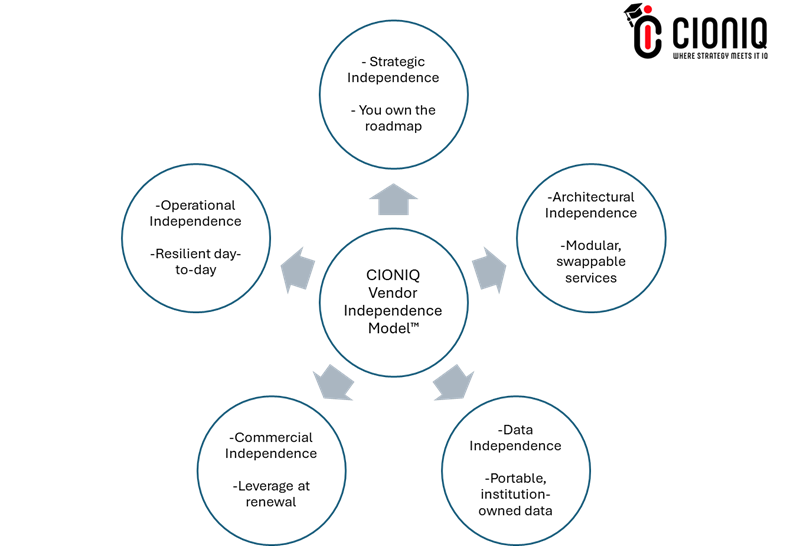
2. The five dimensions of the CIONIQ Vendor Independence Model™
We look at vendor independence across five practical dimensions. Each one gets scored, stress-tested, and then tightened up.
1) Strategic Independence
Core question: Who really sets the IT agenda?
We examine:
- Who decides which projects get funded and in what order.
- Where technology roadmaps originate—from your leadership, or from vendor account plans.
- How tightly IT initiatives are tied to enrollment, retention, and student success metrics.
Goal: A clear, institution-owned digital and IT strategy that vendors align to, not shape.
2) Architectural Independence
Core question: Can you change pieces without breaking everything?
We assess:
- How many “all-in” dependencies you have on a single vendor (infrastructure, ERP, integrations, identity, support).
- Whether your integration, identity, and data platforms create optionality—or just lock you further in.
- How portable your configurations, customizations, and workflows really are.
Goal: A modular, standards-based architecture where you can swap vendors or services without a multi-year heart transplant.
3) Data Independence
Core question: Could you leave tomorrow and take your data and history with you—cleanly?
We review:
- Data ownership clauses and access rights in your contracts.
- How easy it is to export data in usable, documented formats.
- Where “institutional memory” actually lives—inside your systems and documentation, or inside a vendor’s ticketing tool and staff.
Goal: The institution has clean, well-documented data structures and a tested playbook for extracting, migrating, and reporting on its data, regardless of who hosts it.
4) Commercial Independence
Core question: Who has the leverage at renewal time?
We analyze:
- Contract terms: auto-renewals, minimums, ramp-ups, and hidden lock-in clauses.
- SLA design: are they meaningful, measurable, and enforced?
- Pricing transparency and benchmarking: do you know if you’re paying market rates?
- The degree to which vendors bundle critical services in ways that make it hard to rebalance or unbundle later.
Goal: A commercial posture where you know your options, have a clear negotiation strategy, and never renew out of fear of disruption.
5) Operational Independence
Core question: If a key vendor walked away, what actually stops working on Monday?
We look at:
- Where key operational knowledge sits (runbooks, procedures, architecture, and security).
- How incident, change, and problem management are governed—and who signs off.
- What internal capabilities you retain in-house versus fully outsourced.
- The existence (or absence) of transition, exit, and contingency plans.
Goal: A resilient operating model with clear roles, documentation, and fallback options so changes in vendor relationships don’t put the institution at risk.
3. How the model is applied
The CIONIQ Vendor Independence Model™ is designed to be practical and time-boxed. A typical engagement runs 6–8 weeks and follows a structured cadence:
- Discovery and mapping Inventory major vendors, contracts, and critical services (ERP, infrastructure, security, integrations, student-facing platforms). Map who controls what: strategy, architecture, operations, data, and commercial levers.
- Independence maturity scoring Score each of the five dimensions on a simple maturity scale (e.g., Ad-hoc → Dependent → Balanced → Independent). Highlight hot spots where a vendor has outsized control compared to the risk tolerance of the institution.
- Risk and leverage analysis Identify concentration risk (too much in one partner’s hands). Surface “choke points”: systems, contracts, or processes that would make an exit painful or risky. Flag near-term renewals and decision windows where you can regain leverage.
- Future-state operating model Define what “healthy vendor independence” looks like for your institution—what stays outsourced, what comes back in-house, and what requires a multi-vendor structure. Realign roles and decision rights between internal IT, business owners, and vendors.
- Roadmap and quick wins Build a 12–24 month Vendor Independence roadmap, aligned with budget cycles and renewal dates. Identify quick wins—contract clean-ups, documentation sprints, architecture changes—that materially shift leverage in your favor.
4. Key deliverables
When we deploy the CIONIQ Vendor Independence Model™, you don’t just get a slide deck. You get artifacts your leadership can use immediately:
- Vendor Independence Scorecard A one-page view of where you are strong, where you’re exposed, and what needs attention first.
- Vendor Portfolio Map Visual mapping of your vendors across capabilities, with dependency and concentration risk clearly flagged.
- Contract & SLA Heatmap Plain-language summary of your highest-risk clauses, renewals, and commercial opportunities.
- Future-State Sourcing & Operating Model Clear recommendations on what to keep, what to change, and how roles should be distributed between internal staff and external partners.
- Actionable 12–24 Month Roadmap Sequenced actions with owners and timing—so this doesn’t die as a “strategy exercise” but shifts how you actually run IT.
5. When to use the CIONIQ Vendor Independence Model™
The model is especially valuable when:
- You’re approaching a major ERP, infrastructure, or MSP renewal and don’t want to be forced into a decision.
- You’re considering expanding an existing vendor relationship and want to understand long-term implications.
- You feel like vendors are driving the roadmap faster than your governance can keep up.
- You’re planning a modernization program and want to build independence in from day one, not bolt it on later.
6. How it fits with other CIONIQ frameworks
The CIONIQ Vendor Independence Model™ works alongside:
- CIONIQ Governance Framework™ – to define who makes what decisions, with what data, and under what guardrails.
- CIONIQ Modernization Playbook™ – to ensure your modernization investments don’t deepen lock-in, but increase optionality.
Together, they create a coherent approach: governance to steer, modernization to move forward, and vendor independence to keep you in control.
7. Closing thought
Outsourcing isn’t the problem. Blind dependence is.
The CIONIQ Vendor Independence Model™ is how we help higher-ed institutions build healthy, transparent, and strategically aligned vendor relationships—where partners are accountable, options are always on the table, and the institution remains firmly in the driver’s seat.
If you or anyone at your Institution would like templates for any of the Key Deliverables mentioned in 4, you can reach us at contact@cioniq.com – we’re happy to share them at no cost.