CIONIQ Higher-Ed IT Operating Model™
CIONIQ has a structured toolkit of seven proprietary frameworks that we use across every engagement:
- CIONIQ Governance Framework™
- CIONIQ Modernization Playbook™
- CIONIQ Vendor Independence Model™
- CIONIQ Higher-Ed IT Operating Model™
- CIONIQ Risk & Resilience Compass™
- CIONIQ Admissions Integration Blueprint™
- CIONIQ Fractional Leadership Operating Model™
Together, these frameworks give presidents, CFOs, and CIOs a consistent way to regain control of their technology agenda, make defensible decisions, and move faster without handing the steering wheel to vendors. You can read more about these at https://cioniq.com/cioniq-frameworks.
This article is the fourth in that series and focuses on the CIONIQ Higher-Ed IT Operating Model™.
CIONIQ Higher-Ed IT Operating Model™
The CIONIQ Higher-Ed IT Operating Model™ is the blueprint for how technology actually runs at your institution — who does what, how work flows, what stays in-house, what goes to vendors, and how you measure whether any of it is delivering value for students and the business.
Most campuses have pieces of this in people’s heads, org charts, and old strategy decks. The CIONIQ model pulls it together into one coherent, practical design that a President, CFO, CIO, and Board can all understand and govern against.
1. Purpose: Make IT Run Like a Disciplined Business Unit
This model exists to:
- Turn “IT is a cost centre” into “IT is a managed portfolio of services, risks, and investments.”
- Make decision rights explicit: who decides strategy, who owns services, who owns vendors, who owns risk.
- Clarify the split between run, improve, and transform work so you stop starving strategic projects to keep the lights on.
- Align org structure, sourcing, and vendors to the actual services the institution needs — not to historical org charts.
This is the operating layer that sits under the CIONIQ Governance Framework™ and Modernization Playbook™ and makes them real day-to-day.
2. Design Principles
The CIONIQ Higher-Ed IT Operating Model™ is built on a few non-negotiables:
- Student and faculty experience first – everything is anchored to journeys (prospect, applicant, current student, graduate, faculty, staff).
- Business-aligned, not tech-driven – mapped to enrollment, retention, teaching & learning, research, and financial sustainability.
- Cloud-smart and vendor-independent – you choose sourcing based on value and risk, not lock-in or vendor pressure.
- Standardised but pragmatic – ITIL/COBIT where it helps, simplified where it slows the institution down.
- Risk-aware, not risk-avoiding – clear risk ownership and tolerances, especially for cyber and data.
- Transparent economics – you know what each service costs, how it performs, and whether to keep, improve, or retire it.
3. Core Building Blocks of the Operating Model
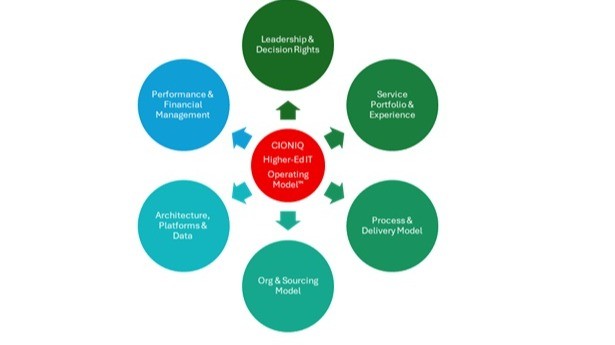
The CIONIQ Higher-Ed IT Operating Model™ is structured into six integrated building blocks:
3.1 Leadership & Decision Rights
Defines who is in charge of what so decisions don’t get stuck in the grey zone.
- Clear CIO mandate and reporting line.
- Role definitions: CIO, CISO, Director-level leaders (Apps, Infrastructure, Data, PMO, Client Services, Teaching & Learning, etc.).
- Formal decision rights for: Strategy and major investments. Architecture and standards. Vendor selection and renewals. Risk acceptance and exception handling.
- Linkages to institutional committees (Cabinet, Board, Finance, Academic, Risk, etc.).
This is where the CIONIQ Governance Framework™ plugs in.
3.2 Service Portfolio & Experience
Defines what IT actually delivers in language the business understands.
- End-to-end service catalogue: Student Information & Enrollment LMS & Digital Learning Identity & Access Collaboration & Productivity Infrastructure & Networks Cybersecurity & Compliance Data & Analytics Campus Systems (housing, facilities, card, parking, etc.)
- Service owners and measurable SLAs/OLAs.
- Experience metrics (NPS/CSAT by persona: student, faculty, staff).
- “Bronze / Silver / Gold” service tiers where appropriate to match cost to value.
This makes it very clear where money and effort are going.
3.3 Process & Delivery Model
Covers how work flows through IT — from idea to production.
- Idea intake and demand management (how projects and requests enter the pipeline).
- Change, release, and incident/problem processes (ITIL-lite, tailored for higher ed).
- Project and program delivery model: When to use agile vs. waterfall vs. hybrid. How to run Banner/ERP upgrades vs. digital product work vs. infrastructure refresh.
- Roles across run / improve / transform: Run: operations, service desk, NOC, basic changes. Improve: enhancements, automation, technical debt clean-up. Transform: modernization, new platforms, M&A, major cloud moves.
This is where the CIONIQ Modernization Playbook™ plugs in.
3.4 Org & Sourcing Model
Defines who does the work and where they sit (internal team, shared services, MSP, offshore, etc.).
- Target org structure aligned to the service portfolio (not just traditional silos).
- Role clarity and career paths for staff (so you can retain key talent).
- Sourcing strategy: What must stay in-house (e.g., enterprise architecture, vendor governance, security leadership, key student-facing capabilities). What can be co-sourced (e.g., 24×7 operations, niche platforms). What can be fully outsourced under strong governance.
- RACI for major domains: ERP / SIS LMS Identity & access Cybersecurity and SOC Network & infrastructure Data & analytics
This is where the CIONIQ Vendor Independence Model™ plugs in — it ensures you stay in control even when delivery is external.
3.5 Architecture, Platforms & Data
Defines the technical backbone that supports the operating model.
- Reference architecture for applications, integrations, and data.
- Principles for selecting and rationalising platforms: Avoid overlapping tools that do the same thing. Standard integration patterns (API-first, message bus, etc.). Clear “source of truth” systems for key data domains.
- Data operating model: Who owns data quality, governance, and analytics. How operational reporting vs. strategic analytics are delivered.
- Roadmap alignment with Modernization Playbook™: What gets kept, modernised, replaced, or retired.
3.6 Performance & Financial Management
Defines how IT performance is measured and funded.
- KPI stack: Service reliability and performance. Project delivery (on time, on budget, benefits realisation). Cyber risk posture. Experience and satisfaction.
- Cost transparency: Run vs. change spend. Cost per service / per user where relevant.
- Chargeback / showback options if the institution wants more cost discipline.
- Quarterly and annual review cadence with Cabinet / Board: What’s working. What isn’t. What decisions are needed.
This turns IT conversations from anecdote and emotion into structured, data-driven discussions.
4. How CIONIQ Uses This Model in Practice
In an engagement, the CIONIQ Higher-Ed IT Operating Model™ is not just theory – it’s the backbone of the work:
- Assess the current state Map current org, vendors, services, and processes onto the model. Identify gaps, duplication, and high-risk areas.
- Design the target operating model Reshape services, roles, sourcing, and governance into a coherent design. Align with institutional strategy, budget reality, and risk appetite.
- Sequence the change Short-term “no-regret” moves (e.g., clarify decision rights, fix critical processes). 12–24 month roadmap to converge org, vendors, and platforms on the target model.
- Embed and govern Use the Governance Framework™, Modernization Playbook™, and Vendor Independence Model™ as the control system to keep the operating model honest over time.
5. The Outcome
When the CIONIQ Higher-Ed IT Operating Model™ is in place, the institution gets:
- A CIO role that’s clearly defined and empowered — not constantly firefighting.
- Staff who know what they own, how success is measured, and how to grow.
- Vendors who work to your model, not the other way around.
- Leadership that can see, in one view, how IT runs and what needs to change next.
It’s the difference between “we think IT is doing its best” and “we know exactly how IT is set up to deliver on our strategy — and we can prove it.”