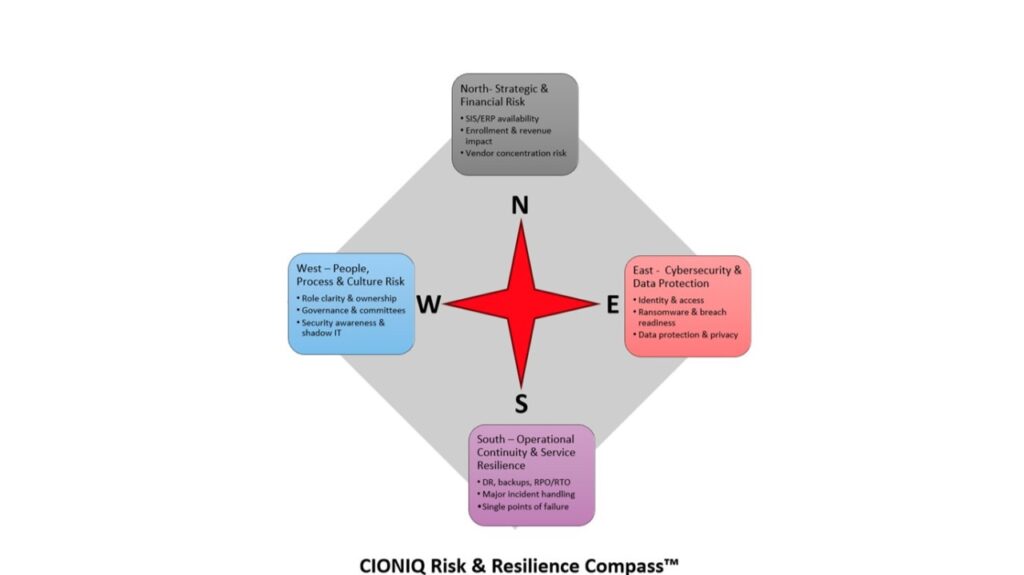
CIONIQ Risk & Resilience Compass™
CIONIQ has a structured toolkit of seven proprietary frameworks that we use across every engagement:
- CIONIQ Governance Framework™
- CIONIQ Modernization Playbook™
- CIONIQ Vendor Independence Model™
- CIONIQ Higher-Ed IT Operating Model™
- CIONIQ Risk & Resilience Compass™
- CIONIQ Admissions Integration Blueprint™
- CIONIQ Fractional Leadership Operating Model™
Together, these frameworks give presidents, CFOs, and CIOs a consistent way to regain control of their technology agenda, make defensible decisions, and move faster without handing the steering wheel to vendors. You can read more about these at https://cioniq.com/cioniq-frameworks.
This article is the fifth in that series and focuses on the CIONIQ Risk & Resilience Compass™.
CIONIQ Risk & Resilience Compass™
CIONIQ Risk & Resilience Compass™ is your institutional GPS for technology risk – a practical way to see where you’re genuinely exposed, where you’re over-investing, and where resilience is just a PowerPoint word instead of an operational reality.
Think of it as the control panel that connects your governance, modernization, and vendor decisions into a single, honest view of risk and readiness.
1. What the Risk & Resilience Compass™ Is
The CIONIQ Risk & Resilience Compass™ is a structured framework that helps higher-ed institutions:
- Identify the real technology and cyber risks that can disrupt teaching, enrollment, and revenue
- Prioritize what actually matters (not just what vendors are selling or auditors last asked about)
- Align Board, Cabinet, CIO, CISO, and IT leadership on risk appetite and trade-offs
- Operationalize resilience – so incident response, DR, and continuity are lived practices, not binders on a shelf
It’s built for colleges and universities that:
- Have piecemeal risk registers across IT, cyber, audit, and compliance
- Are over-reliant on vendors for “risk ratings”
- Know that a single outage, breach, or ransomware incident can derail the institution’s brand and finances
2. The Four Compass Points
The Compass is structured into four directions – each one is a lens on risk and resilience:
North: Strategic & Financial Risk
Focus: What could materially impact the institution’s strategy, revenue, and viability?
Typical areas:
- SIS/ERP availability and integrity (registration, billing, financial aid)
- Enrollment-critical systems (LMS, portal, CRM, ID management)
- Vendor and outsourcing concentration risk
- Long-term technical debt and deferred investment
North forces the conversation: “If this fails for a week, what does it do to our students, our cash flow, and our reputation?”
East: Cybersecurity & Data Protection
Focus: How exposed are we to a breach, ransomware, or data loss – and how fast can we contain it?
Typical areas:
- Identity and access management (who can access what, and how is it governed?)
- Endpoint, email, and cloud security controls
- Data classification and protection (student, HR, finance, research)
- Third-party/vendor security posture and contracts
- Incident response, tabletop exercises, playbooks
East is where we separate “we bought tools” from “we can actually handle an incident at 2:00 a.m.”
South: Operational Continuity & Service Resilience
Focus: Can we keep teaching, supporting students, and running the institution during disruption?
Typical areas:
- Disaster recovery posture (RPO/RTO backed by real testing)
- Backup design and ransomware-resilient architectures
- Single points of failure (network, data center, key staff, key vendors)
- Major incident management processes and escalation paths
- Cross-functional continuity (IT, HR, Registrar, Finance, Academic leadership)
South exposes where continuity is still a “document exercise” vs. a reliable, tested capability.
West: People, Process & Culture Risk
Focus: Are people, processes, and culture aligned to operate securely and resiliently?
Typical areas:
- Role clarity for CIO, CISO, Data Stewards, and system owners
- Governance structures – committees, decision rights, escalation
- Security awareness and reporting culture
- Shadow IT and “workarounds” that quietly increase risk
- Change management for major technology initiatives
West is often where risk silently accumulates: unclear ownership, workarounds, and “this is how we’ve always done it.”
3. How CIONIQ Uses the Compass in Practice
The CIONIQ Risk & Resilience Compass™ is not just a slide – it’s a working method we use with your leadership and IT teams:
- Rapid Risk Scan (Compass Baseline) Short, structured interviews with CIO, CISO (or equivalent), CFO, Registrar, HR, and Academic leadership Review of key artifacts (DR plans, incident logs, audits, contracts, security tools) Initial scoring across the four compass points (0–5 maturity or Low/Med/High risk)
- Heatmap & Narrative Visual Compass Heatmap showing where the institution is exposed Plain-language narrative for Cabinet and Board: “Here’s where we are secure enough.” “Here’s where we are under-invested and exposed.” “Here’s where we’re spending money but not reducing risk.”
- Institution-Specific Risk Register Prioritized list of risks with: Likelihood / impact Control gaps Accountable owners Time-bound remediation actions Mapped directly to the four compass points so leadership sees the whole picture, not a random risk list.
- Resilience Roadmap (12–24 Months) A pragmatic sequence of actions that fits budget, capacity, and politics, not fantasy-land Linked to CIONIQ Modernization Playbook™ and Governance Framework™ so risk work and modernization aren’t running in separate silos
- Ongoing Governance & Monitoring Integrate Compass metrics into: CIO Cabinet updates Board/Cabinet quarterly risk decks Vendor performance reviews
4. Where the Compass Fits in the CIONIQ Ecosystem
The Risk & Resilience Compass™ is the risk lens across all CIONIQ work:
- In the CIONIQ Governance Framework™, it informs decision rights, committees, and escalation.
- In the CIONIQ Modernization Playbook™, it shapes how you prioritize projects – what reduces real risk vs. what’s just “shiny.”
- In the CIONIQ Vendor Independence Model™, it pushes you to negotiate contracts, SLAs, and exit options based on risk and resilience, not vendor marketing.
Net result: you don’t just “do projects” or “buy tools”. You de-risk the institution in a visible, measurable, and defensible way.
5. Typical Deliverables from a CIONIQ Compass Engagement
When we deploy the CIONIQ Risk & Resilience Compass™, institutions can expect:
- Compass Heatmap & Executive Summary
- Risk Register & Control Gap Analysis (aligned to the four compass points)
- Resilience Roadmap (12–24 Months) – projects, quick wins, and structural fixes
- Major Incident & Ransomware Playbook (if needed)
- Board/Cabinet Deck translating risk into business and student-impact language
If you or anyone at your Institution would like to see examples for the above Deliverables mentioned, you can reach us at contact@cioniq.com – we’re happy to share them at no cost.