CIONIQ Admissions Integration Blueprint™
CIONIQ has a structured toolkit of seven proprietary frameworks that we use across every engagement:
- CIONIQ Governance Framework™
- CIONIQ Modernization Playbook™
- CIONIQ Vendor Independence Model™
- CIONIQ Higher-Ed IT Operating Model™
- CIONIQ Risk & Resilience Compass™
- CIONIQ Admissions Integration Blueprint™
- CIONIQ Fractional Leadership Operating Model™
Together, these frameworks give presidents, CFOs, and CIOs a consistent way to regain control of their technology agenda, make defensible decisions, and move faster without handing the steering wheel to vendors. You can read more about these at https://cioniq.com/cioniq-frameworks.
This article is the sixth in that series and focuses on the CIONIQ Admissions Integration Blueprint™.
CIONIQ Admissions Integration Blueprint™
A Banner-First, Extensible Approach to Fixing Admissions Plumbing
Most institutions don’t have an admissions integration strategy. They have years of point-to-point fixes that “mostly work” — until they don’t.
CRM, SIS (e.g. Banner), portals, payment systems, marketing tools, and identity platforms are all in play. Each new vendor promises to “integrate,” but behind the scenes you’re juggling flat files, custom scripts, and brittle APIs that nobody fully owns.
The impact is predictable:
- Duplicate and dirty data in SIS
- Conflicting numbers between Admissions, Enrollment, and Institutional Research
- Manual workarounds inside the Admissions office
- Slow time-to-decision for applicants
- A disjointed experience for students and staff
CIONIQ’s Admissions Integration Blueprint™ was built to address this exact problem — with Banner as the system of record, but patterns that extend cleanly to other SIS and CRM platforms.
What the Blueprint Is (and Is Not)
The CIONIQ Admissions Integration Blueprint™ is:
- A reference architecture for the full prospect → applicant → admit → enrolled lifecycle
- A governance model that defines ownership, SLAs, and decision rights across IT and Enrollment
- A set of integration patterns and standards that vendors must align to — not the other way around
It is not:
- A product you have to buy to get locked into
- Another one-off “integration project” that solves today’s problem and creates tomorrow’s technical debt
- A generic diagram that ignores how SIS (e.g. Banner®) actually works in the real world
The goal is simple: create a repeatable way to plug in new systems, manage data end-to-end, and protect SIS (e.g. Banner®) as a trusted source of truth.
The Core Problems We See in Admissions Integrations
Across institutions, the failure patterns are remarkably consistent:
- No single owner of the data flow Admissions owns the CRM. IT owns the SIS. Marketing owns campaigns. Nobody owns the end-to-end journey.
- Multiple “sources of truth” Decision codes, application stages, test scores, and program mappings don’t line up between CRM and SIS (e.g. Banner®). Leadership doesn’t know which numbers to trust.
- Custom one-offs everywhere Each new platform arrives with its own file layouts, APIs, and logic. Integrations get hard-coded, not standardized. When staff leave, knowledge leaves with them.
- Shadow systems in Admissions Spreadsheets and personal trackers appear to “bridge the gaps,” creating even more risk and inconsistency.
- No clear service levels or monitoring When files don’t load or APIs fail, Admissions discovers it from an angry applicant, not from proactive monitoring.
The Blueprint is designed to attack these exact pain points.
Design Principles Behind the Blueprint
The CIONIQ Admissions Integration Blueprint™ is built around a few non-negotiable principles:
- SIS (e.g. Banner®) is the authoritative system of record for student and applicant data. CRMs, portals, and marketing platforms are powerful — but they are satellites around the SIS, not replacements for it.
- One admissions data model, many channels. The core concepts — application, program, term, decision, status, checklist — are defined once and reused everywhere.
- Standard patterns beat custom heroics. APIs, iPaaS flows, and flat-file exchanges are standardized so you’re not reinventing the wheel for each vendor.
- Governance and monitoring are baked in, not bolted on. Ownership, SLAs, error handling, and auditability are part of the design, not an afterthought.
- Vendor-neutral and extensible. The architecture must survive a CRM swap, a portal refresh, or a new marketing stack without being ripped up and rebuilt.
What the Blueprint Includes
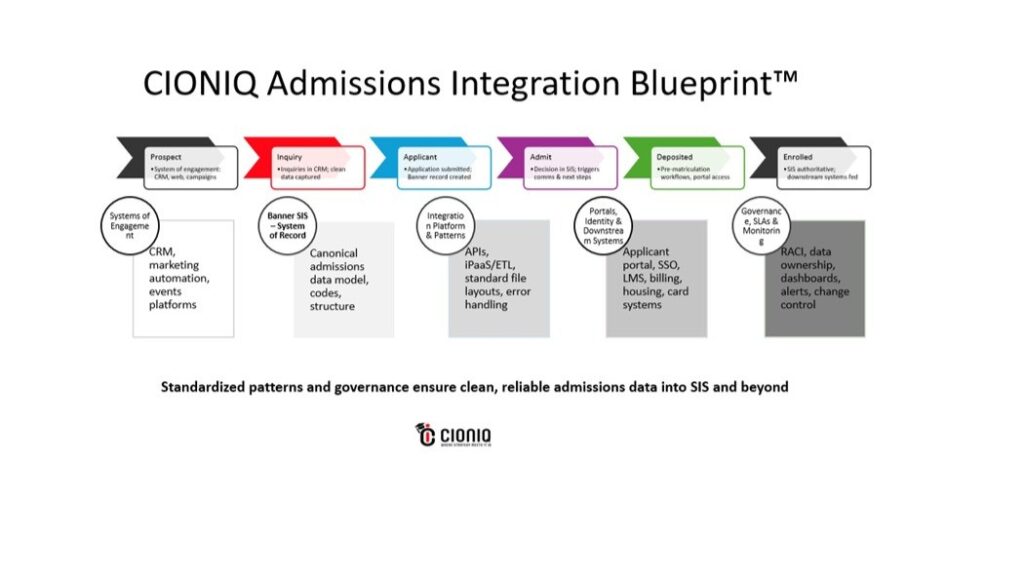
1. End-to-End Process and Data Flow
We start by mapping the full lifecycle:
Prospect → Inquiry → Applicant → Admit → Deposited → Enrolled
For each stage, the Blueprint defines:
- Which system is system of record
- What data is captured or updated
- How and when it moves into SIS (e.g. Banner®)
- Which events trigger communications, workflows, or identity changes
This isn’t just a pretty flowchart. It becomes the operating map for Admissions, IT, and vendors.
2. SIS-Centric Admissions Data Model
Next, we standardize the SIS view of admissions:
- Application types and levels
- Programs and majors
- Terms and parts of term
- Decision codes and status codes
- Checklist items and holds
- Recruiting sources and campaign codes
The Blueprint documents:
- The canonical code sets and values
- How external systems must map their fields
- What happens when new programs, modalities, or locations are introduced
This is what stops “creative” local configuration from silently breaking integrations.
3. Integration Patterns and Technical Standards
The Blueprint defines a limited, manageable set of patterns:
- Real-time APIs for high-value events (e.g., application creation, decision updates)
- Scheduled iPaaS or ETL jobs for bulk loads and nightly refreshes
- Standard file formats only when APIs are not feasible
For each pattern, we specify:
- Required fields and validation rules
- Error handling and retry behavior
- Logging and monitoring expectations
- Security and encryption standards
Vendors don’t get to improvise; they align to the institution’s blueprint.
4. Identity, Access, and Portals
Admissions integrations don’t stop at the SIS. We define how:
- Applicants are provisioned into identity platforms (e.g., Entra ID, Okta)
- Portal and self-service experiences are aligned with application and decision status
- Pre-matriculation services (housing deposits, orientation sign-ups, placement tests) are triggered off Banner data
This keeps the student experience coherent instead of fragmented across tools.
5. Governance, Roles, and SLAs
Technology alone won’t fix integration chaos. The Blueprint includes:
- RACI matrices for Admissions, IT, IR, and vendor partners
- Integration catalogue (what exists, who owns it, criticality, dependencies)
- SLA definitions for data latency, uptime, and issue response
- Change management steps when adding new programs, codes, or platforms
This is where many institutions fail today — integrations exist, but nobody formally owns them.
“Banner-First, but Extensible”: What That Really Means
The Blueprint is built around Ellucian Banner(r) — tables, processes, and constraints included. That matters because:
- We design to how Banner(r) actually behaves, not an abstract, vendor slideware view.
- We take advantage of existing Banner capabilities instead of bypassing them with heavy custom code.
At the same time, the patterns are fully extensible:
- If you change CRMs, the core data model and integration patterns stay put.
- If you add a new marketing or event platform, it plugs into the existing architecture.
- If you ever change SIS platforms, you port a known blueprint — not guess from scratch.
The result is an admissions integration landscape that can evolve without collapsing every three years.
What Institutions Gain
When the CIONIQ Admissions Integration Blueprint™ is implemented, institutions typically see:
- Cleaner, more reliable admissions data in your SIS (Banner or Jenzabar)
- Faster time-to-decision and fewer “stuck” applications
- Reduced manual rekeying and spreadsheet workarounds in Admissions
- Aligned reporting between Admissions, Enrollment, and Institutional Research
- A better applicant and staff experience — fewer surprises, fewer errors
- Lower integration risk when bringing in new vendors or retiring old ones
In short: you move from reactive fixes to a scalable, intentional admissions architecture.
How CIONIQ Engages
A typical engagement around the CIONIQ Admissions Integration Blueprint™ includes:
- Discovery & Current-State Mapping Inventory systems, integrations, data models, and pain points.
- Blueprint Design & Governance Model Produce the target architecture, Banner data model, standards, and RACI.
- Roadmap & Quick Wins Prioritize fixes and improvements that deliver value within the first 90–180 days.
- Implementation Support & Vendor Alignment Work with your internal teams and vendors to align to the new blueprint.
The deliverables are built so that your institution can own and evolve the model going forward — with or without ongoing CIONIQ support.
Closing Thought
Admissions and enrollment strategy lives or dies on execution. You can’t execute well if your systems are out of sync and nobody can trust the data.
The CIONIQ Admissions Integration Blueprint™ is about getting the plumbing right — once — so your teams can focus on recruiting and serving students, not chasing broken files and mismatched records.
If your institution is wrestling with SIS (e.g. Banner®), CRM, and admissions integrations, this is exactly the space CIONIQ was built to operate in.
If you or anyone at your Institution would like to see examples for the Deliverables mentioned above, you can reach us at contact@cioniq.com – we’re happy to share them at no cost.